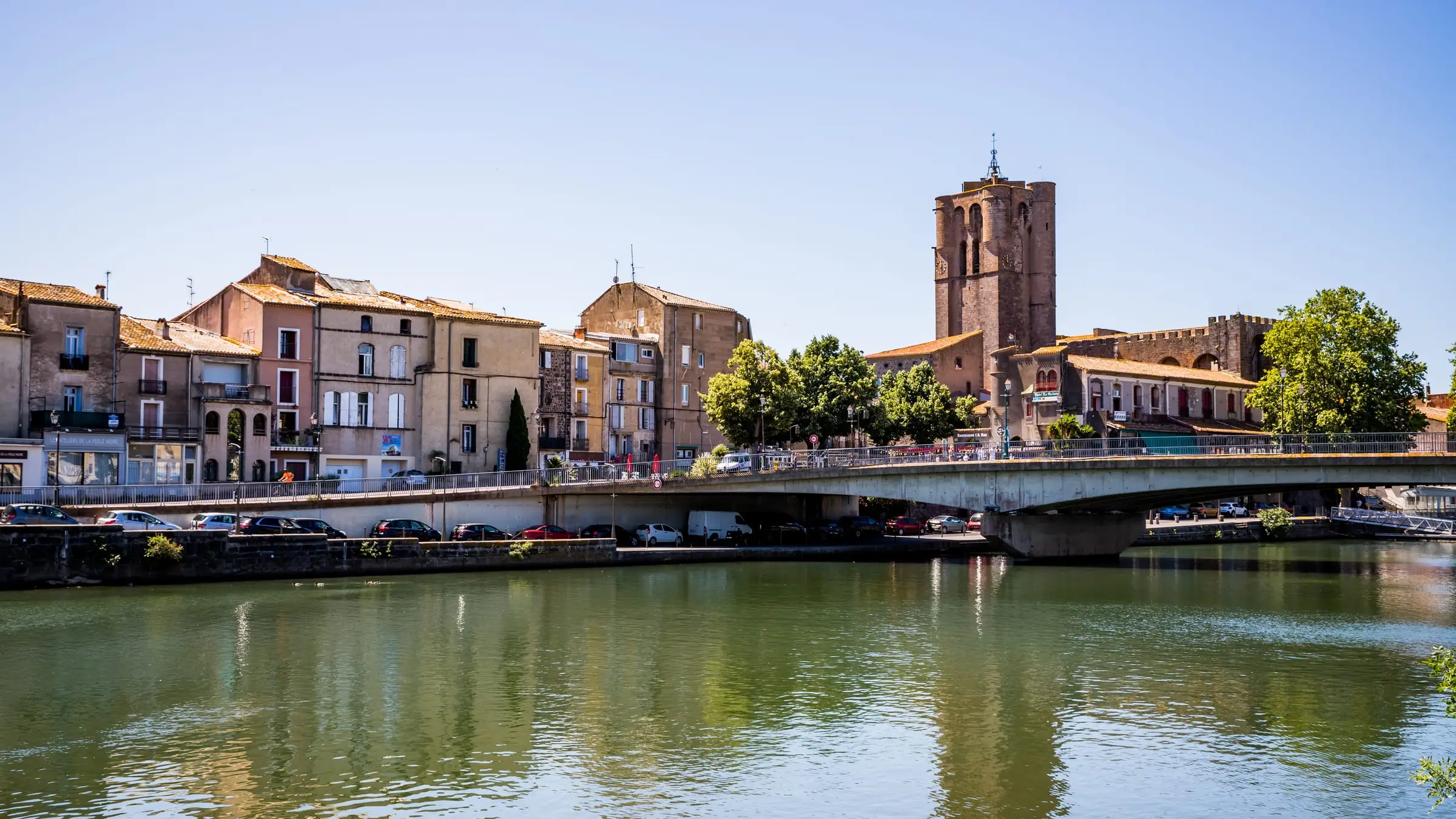
Agde, on the Languedoc coast in the South of France, is known as the black pearl of the Mediterranean. Its dark stone comes from a volcano, its beginnings from the Greeks and its character today from the sea. One town holds a medieval centre, a river, a fishing quarter and a whole seaside resort: enough for an entire stay.
A town born of the Greeks and a volcano
In the sixth century BC, Greeks from Massalia, now Marseille, settled on a mound of basalt above the left bank of the Hérault. Their trading post grew into a city, Agathe Tyche, ‘good fortune’. The black stone of the neighbouring volcano then built the town itself: narrow lanes, dark façades, quays along the river.
The river still keeps the memory of that past. In 1964, divers found an ancient bronze of rare beauty in its bed, the Ephebe of Agde. It is now on show at the Musée de l’Éphèbe at Cap d’Agde, a museum of underwater archaeology and a good visit with children, among amphorae and bronzes raised from the water.
Saint-Étienne Cathedral, a fortress of lava stone
On the riverbank, Saint-Étienne Cathedral is closer to a castle than to a church. Fortified from 1173 by Bishop Guillaume and built entirely of basalt, it has battlements, machicolations and a wall-walk, and its keep rises 35 metres. It has been classified as a historic monument since 1840.
Push open the door. In the half-light, a seventeenth-century altarpiece carved from Carrara and Caunes-Minervois marble catches what light there is. After so much black stone outside, the contrast is striking.
Mont Saint-Loup, a volcano facing the sea
Born of an eruption some 740,000 years ago, Mont Saint-Loup rises to 113 metres. Paths cross its slopes and, at the summit, the old semaphore station keeps watch over the coast. The view takes in Cap d’Agde and its harbours and, out at sea, Fort Brescou.
The fort stands on a basalt islet, all that remains of an ancient undersea volcano. Begun in 1586 and reworked in Vauban’s day, it served as a state prison until the middle of the nineteenth century. Registered as a historic monument in 1996, it now belongs to the town.
At the foot of the volcano, the beach of La Grande Conque spreads its black sand beneath cliffs of lava. It is a rare sight on the French coast, and best seen in the morning.
The Hérault, from the old town to the sea
The river crosses Agde before reaching the Mediterranean. At the edge of town, the Round Lock links the Canal du Midi to the river. Conceived by Pierre-Paul Riquet and built of basalt, it owes its circular shape to a simple idea: boats turn inside it and leave in any one of three directions. It remains one of the canal’s curiosities.
At the river mouth, Le Grau-d’Agde has kept the soul of a fishing village: busy quays, painted boats, a family beach. On the far bank, the pine wood of La Tamarissière, planted in 1782, shades a wilder beach. In the warmer months a ferryman carries passengers between the two banks in a few minutes, the prettiest crossing in town.
Cap d’Agde, a resort designed around its harbours
Cap d’Agde was born in 1970 as part of the Mission Racine, the great plan to develop the Languedoc coastline. The architect Jean Le Couteur designed it around its harbours, in successive rings of quays, residences and leisure areas. Its first phase, Port Saint-Martin, carries the French label for remarkable contemporary architecture.
With 14 km of beaches within the commune, everyone finds a stretch of shore of their own. Families can mix swimming, strolls along the quays and a look beneath the surface: in summer, the protected marine area off the Agde coast has a marked underwater trail to follow with mask and snorkel.
Agde’s natural side
East of the town, the Bagnas national nature reserve, created in 1983, protects a lagoon and its marshes, where more than 200 species of bird have been recorded. The heart of the reserve is visited on guided tours, booked in advance, binoculars in hand. It is another Agde altogether, quiet and full of light, a few minutes from the beaches.
A day in Agde, for example
Climb Mont Saint-Loup in the morning, before the heat, then walk down to La Grande Conque for a first swim. Back at the villa, lunch in the cool. The afternoon belongs to the old town and the cathedral, when the basalt lanes hold on to their shade. In the evening, head for the quays at Le Grau-d’Agde and watch the sun set behind the pines of La Tamarissière.
Staying in Agde
On the heights of Agde, Villa Halo looks over its garden and lagoon pool to the sea. At Le Grau-d’Agde, Villa Signature and Villa Summer Wind are made for long tables, with pools, palm trees and evenings outdoors. All our villas in Agde are on the page for villa rental in Agde.
A sailing trip along the coast, a visit to the Bagnas booked in advance, a chef cooking dinner while the light fades over the volcano: our concierge service takes care of it, so that your days stay entirely your own.


