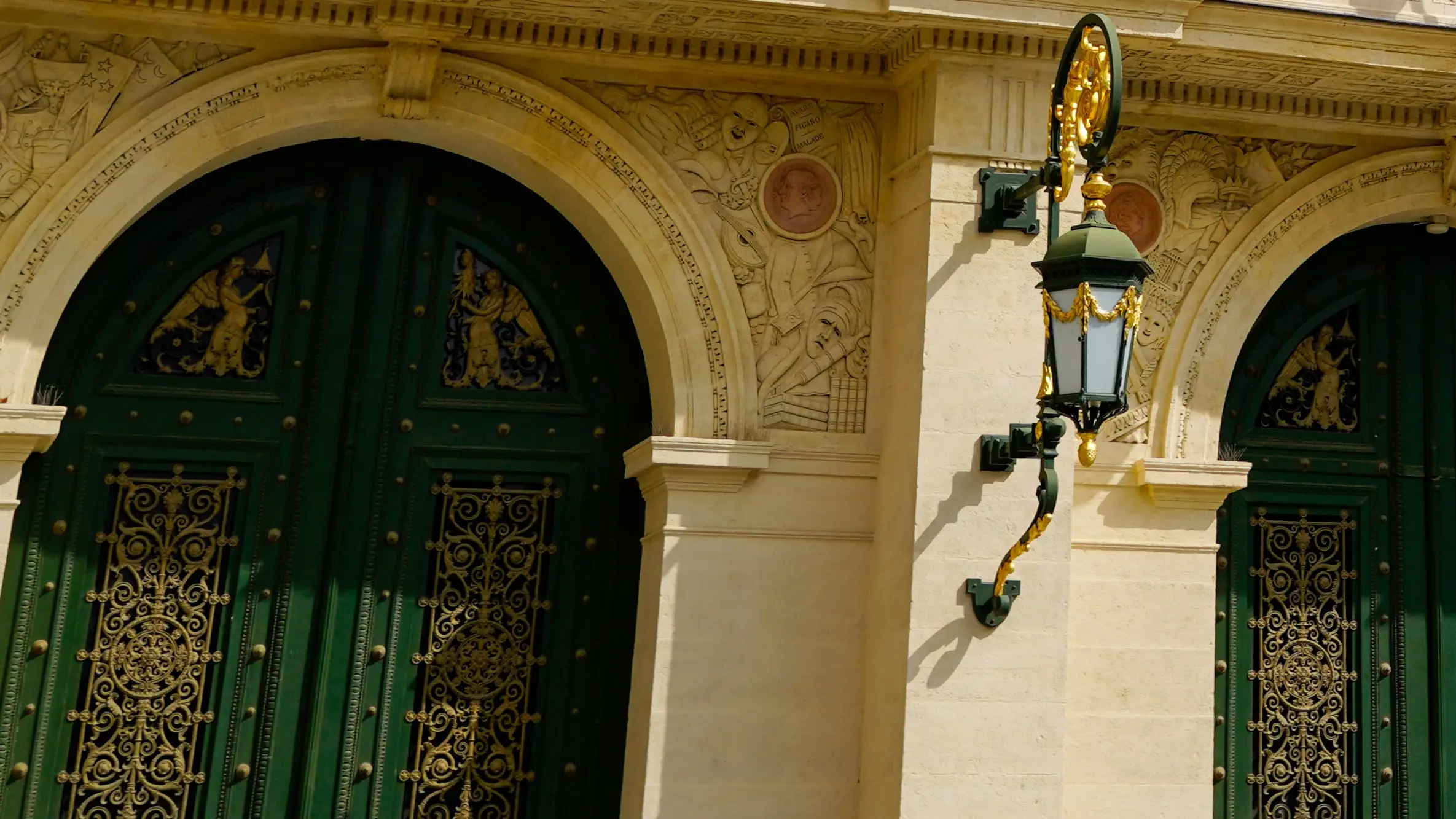
In the middle of the seventeenth century, Molière played in Pézenas before the Estates of Languedoc. The town has kept the stage set: grand town houses, cobbled lanes, craft workshops and a market held every Saturday for almost six hundred years. A day is enough to see it; you will want to return to savour it.
Molière and the Estates of Languedoc
Pézenas hosted the Estates of Languedoc, the province’s assembly, on several occasions. In 1650, the company of Charles Dufresne, in which Molière acted, was engaged to entertain the delegates. In 1653, the Prince of Conti, a great nobleman with a passion for the theatre, took the players under his protection: they stayed in town in 1653 and 1654, and again for the winter session of the Estates in 1655–1656. The patronage ended when the prince turned to religious devotion, and the company soon left the region.
Local tradition has it that Molière liked to linger in the barber Gély’s shop, for the sheer pleasure of watching people go by. More than one of his future characters is said to owe something to these years in the Languedoc. Molière’s real name was Jean-Baptiste Poquelin, and Marcel Pagnol put it in a line: ‘If Jean-Baptiste Poquelin was born in Paris, Molière was born in Pézenas.’
Along the Cours Jean-Jaurès, on the way to the theatre, ceramic plaques carry the footprints of people of the stage: these are ‘Molière’s footsteps’. Each year, during the festival devoted to the playwright, new artists come to leave their mark. The theatre itself, installed in 1803 in a former penitents’ chapel and reopened to the public in 2012, is a listed historic monument.
Town houses and hidden courtyards
Pézenas was one of the first towns in France to protect its historic centre: its conservation area dates from 1965. Some thirty town houses (hôtels particuliers), built between the fifteenth and eighteenth centuries, tell of its prosperity. The Hôtel de Lacoste and its staircase, the Hôtel d’Alfonce, built between 1590 and 1603, the Hôtel des Juvenel: behind carved gateways open inner courtyards, towers and mullioned windows.
The town is best read by looking up. More than a hundred mascarons, carved stone faces, decorate the façades. Round a corner, the Porte Faugères, a remnant of the medieval walls, marks the entrance to the old Jewish quarter, whose lanes still follow their medieval layout.
A tip: the private courtyards can be seen on the town’s guided tours, or when a door has been left ajar. The European Heritage Days in September open more of them.
A town of craftspeople
Pézenas holds the Ville et Métiers d’Art label and has turned its streets into a workshop. Cabinetmakers, glassblowers, potters, ceramicists, jewellers and leatherworkers often work in full view of passers-by. The former consular house, a historic monument, is home to the Maison des Métiers d’Art, which shows a wide selection of their work. This is the place to take home a one-off piece rather than a souvenir: a blown-glass vase, a turned bowl, a signed piece of jewellery.
Pézenas is also a town for antiques hunters: furniture, faience and curios turn up as you wander from street to street.
Saturday morning: the market
Pézenas has held a market every Saturday since Charles VII granted letters patent in 1434. The centre comes alive early: local produce, flowers, crafts and an organic market in the Square du Poilu. Come early, wander, then try the town’s speciality, the petit pâté de Pézenas, a small sweet-and-savoury lamb pastry flavoured with lemon zest. Tradition credits its origin to the cooks of Lord Clive, better known as Clive of India, who stayed in the town in 1768.
The Poulain, the carnival and Boby Lapointe
The town’s totem animal, the Poulain (the foal) of Pézenas, leads the carnival. It is one of the processional giants and dragons of Belgium and France recognised by UNESCO as intangible cultural heritage of humanity. If your stay coincides with the festivities, do not miss its outing: the whole town follows.
Pézenas was also the birthplace, in 1922, of the singer Boby Lapointe, a friend of Georges Brassens. A small museum and a festival each spring keep his playful spirit alive.
The wine of Pézenas
Around the town, vines grow on an unusual terroir marked by ancient basalt lava flows. The Languedoc Pézenas appellation, recognised in 2007, is reserved for red wines; it is one of the appellations to explore around our villas. To discover it without taking the wheel, our concierge service can arrange a private visit to an estate, or a tasting at the villa with a wine expert.
Staying among the vines
At the gates of Pézenas, Domaine Sainte-Cécile du Parc is a genuine wine estate: a large house of character surrounded by vines, a garden, a pool and the winery close by. You visit the town in the morning, swim in the afternoon and dine outdoors when the heat falls. The sea is still within reach for a day on the beaches of the Agde coast.
To compare it with our houses by the sea, browse all our villas: each has been chosen for its setting and is prepared by our team before you arrive.


