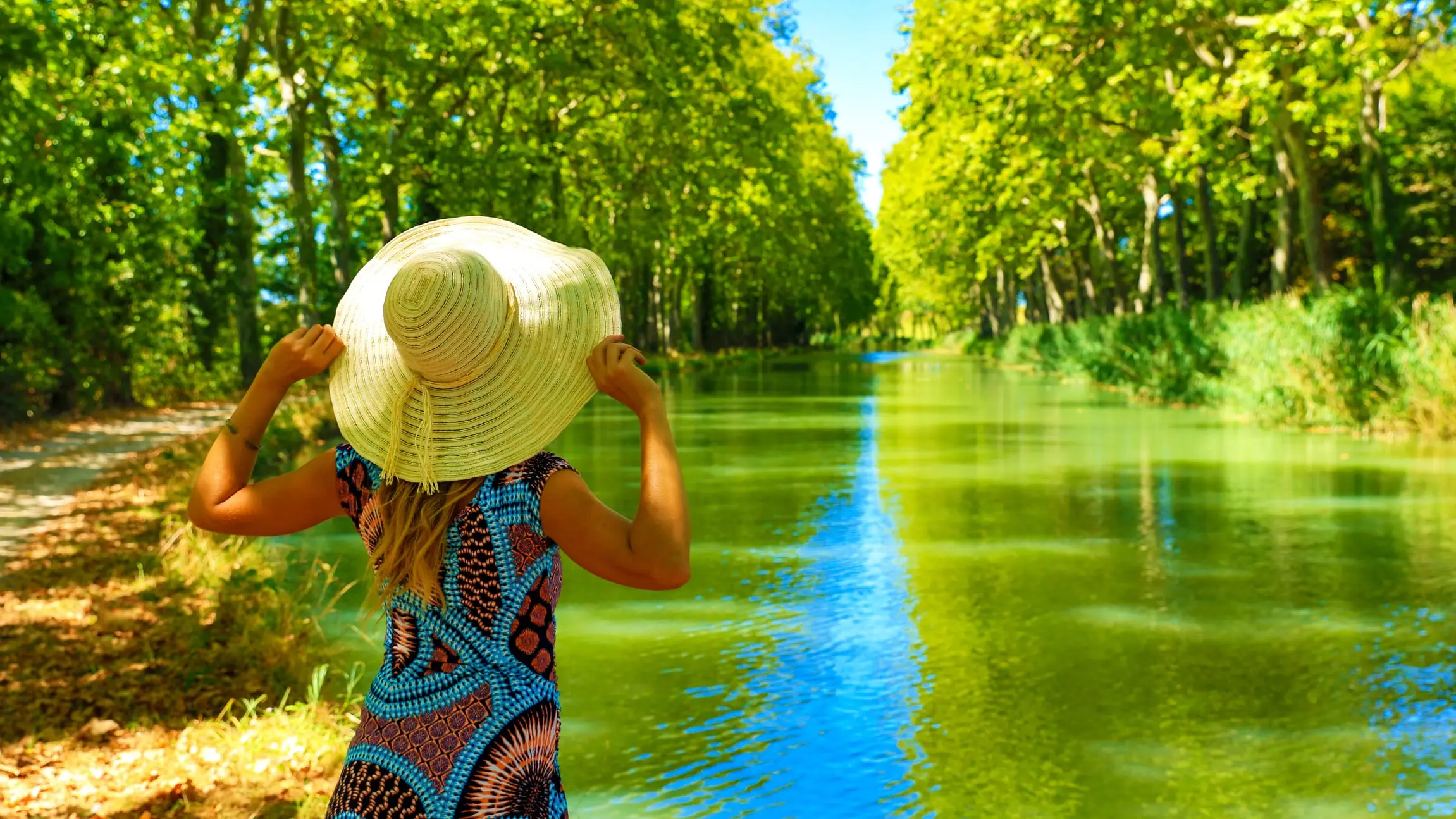
Pierre-Paul Riquet was born in Béziers, and it is around his home town that his canal gathers its most remarkable works. By bike, on an almost flat towpath, there are two rides to choose from: one towards the hills and a lake drained in the Middle Ages, the other to the sea.
A World Heritage canal, from the saddle
A UNESCO World Heritage Site since 1996, the Canal du Midi joins the Atlantic to the Mediterranean through a network of 360 km, built between 1667 and 1694, with 328 structures: locks, bridges, aqueducts and tunnels. Around Béziers, the most remarkable follow one another within a few kilometres. The towpath, once used to haul the barges, suits a bike well: you ride beside the water, between vines and pines, away from the traffic.
Heading west: Fonseranes, the Malpas tunnel and Montady
Start at the nine locks of Fonseranes, a staircase of water 312 metres long that rises 21.5 metres. The path runs alongside, in a short climb that you take at walking pace, watching the boats pass from one basin to the next. Above the locks begins the canal’s longest pound, a stretch of 54 km without a single lock. The canal winds along the lie of the land as far as the port of Colombiers.
A kilometre beyond the port, about 8 km from the locks, the Malpas tunnel carries the canal under the hill of Ensérune. Cut in 1679, it is said to be the first navigation tunnel in Europe. Riquet had it dug despite doubts about rock thought too crumbly. The path through it is narrow, so you walk. Here three structures lie one above another beneath the hill: the canal, a nineteenth-century railway tunnel and, lower still, the medieval gallery that drains the Étang de Montady.
Then climb to the oppidum of Ensérune, an ancient hilltop settlement: this is the day’s one real climb. Inhabited from the sixth century BC to the first century AD, the site is run by the Centre des monuments nationaux and has an archaeological museum. Above all, it has the view over the Étang de Montady. Drained in the thirteenth century, after a charter of 1247, the former lake forms an immense sun: triangular plots converging on the centre, from which the water escapes through a gallery dug beneath the hill.
Allow about 20 km there and back from the locks, plus the climb to Ensérune.
Towards the sea: Béziers to Portiragnes-Plage
In the other direction, the canal leaves Béziers eastwards, passing Villeneuve-lès-Béziers and then Portiragnes. At the Roque-Haute bridge, a cycle path runs to the beach: about 13 km from Béziers, with a swim as your reward. On the way, the nature site of La Grande Maïre, between canal and sea, shelters lagoons, reed beds and waterbirds.
The more determined can carry on to the round lock at Agde, some 26 km from Béziers. For the return, the regional train links Agde, Vias and Béziers; bikes are carried subject to space, on terms that change with the season.
Which bike, which path
The towpath was not designed for cyclists. Depending on the section, it alternates between compacted surface, gravel and earth, with some stony or narrow stretches. The official Canal des 2 Mers à vélo route recommends a hybrid, a mountain bike or a gravel bike with sturdy tyres, ideally puncture-resistant. An e-bike makes the climb to Ensérune a footnote.
Resurfacing work takes place regularly, so check the state of the route on the official Canal des 2 Mers à vélo website before you set off. On the path, give way to pedestrians and slow down at the locks and near the harbours, where you will meet walkers and boaters.
When to go
Spring and autumn are the best seasons: soft light, mild temperatures, vines turning green and later taking on their harvest colours. In summer, set off early: the heat builds quickly and the shade is no longer continuous. Since 2006, canker stain, a fungal disease, has killed most of the canal’s plane trees; since 2012, Voies navigables de France, the waterways authority, has been replanting with a mix of species, led by Turkey oak. The young trees are growing, but some stretches remain exposed.
Winter brings crystal-clear days. Just mind the tramontane, a north-westerly wind that can blow hard: head out into it and it will carry you home.
What to take
- Plenty of water, especially from May to September.
- A hat, sunglasses and sun cream.
- A spare inner tube, a pump and a bike lock.
- Swimwear and a towel if you are heading for Portiragnes-Plage.
- A picnic for the water’s edge.
Back at the villa
At Portiragnes, Villa Paulina stands in the heart of the village the canal runs through, so you can set off by bike from the doorstep. Closer to Béziers, Villa Andria has a pool waiting for your return. All our villas around Béziers are on the page for villa rental in Béziers.
Our concierge service can book your table, bring in a chef for dinner or arrange a massage at the villa: the day ends as it began, without hurry.


