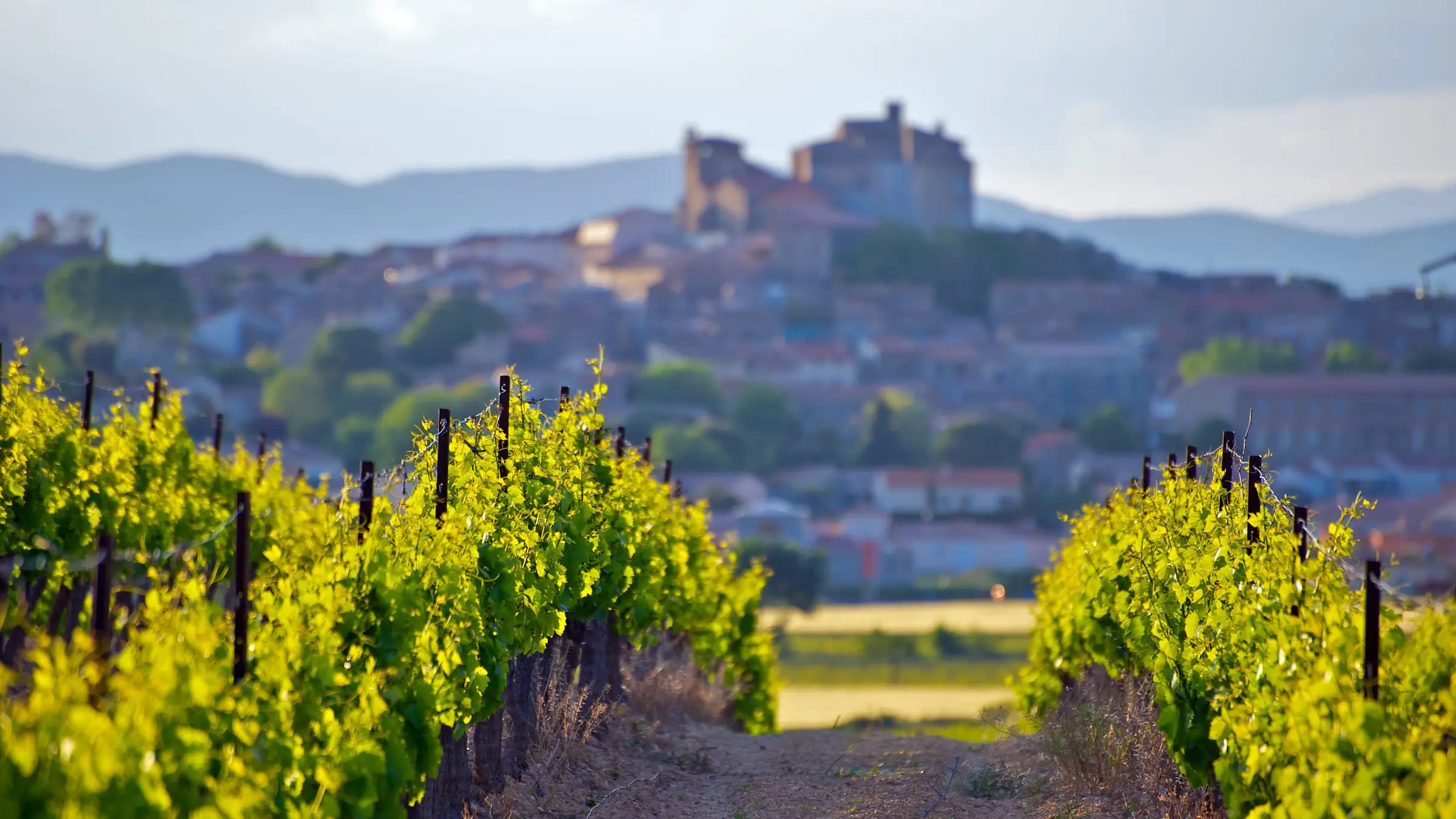
Many of us first met Languedoc wine on a shelf at home; it tastes different where it grows. From the shores of the Étang de Thau to the schist of the first foothills, the vineyards begin where the garden ends. Five names are enough to find your way, and one rule to enjoy them: take your time.
Picpoul de Pinet, the white wine of the lagoon
Between Agde, Pézenas and the Étang de Thau, six villages grow one grape variety and one only: piquepoul blanc. Pinet, Pomérols, Florensac, Castelnau-de-Guers, Montagnac and Mèze make up the Picpoul de Pinet area, an appellation in its own right since 2013, after many years under the Coteaux du Languedoc banner.
The wine is always white. Pale gold, lively, with notes of citrus and white flowers: the lagoon tempers the heat and keeps it fresh. It is drunk young, and almost always with the best of what the lagoon produces. Thau oysters and a glass of picpoul are a classic of this coast, and have lost none of their charm.
The landscape alone is worth the detour: garrigue and pinewoods to the north, plateaux sloping gently down to the water in the south, and the Via Domitia, the old Roman road, running straight through the vines.
Faugères, the schist appellation
North of Béziers, seven villages share the Faugères appellation: Autignac, Cabrerolles, Caussiniojouls, Faugères, Fos, Laurens and Roquessels. What they have in common lies underfoot: a very old, uniform schist, with no equivalent in the Languedoc across a whole appellation. The vines follow the contours of the hills, on terraces climbing to several hundred metres.
The reds and rosés have held appellation status since 1982, the whites since 2005. The reds have depth and silky tannins; the whites, a clear minerality. The same land also yields a brandy, the Fine de Faugères.
For the view, head up to the Faugères windmills. Three sixteenth-century towers crown the hill, and one has been given back its machinery and millstones. From the top, the eye runs over the vines all the way to the sea.
Saint-Chinian, two terroirs and a river
Saint-Chinian spreads over 20 villages along a diagonal, and across two landscapes: to the north-west, schist, steep slopes and terraces; to the south-east, clay and limestone with gentler contours. The appellation, recognised in 1982, plays on this contrast. Since 2005, two named areas, Berlou and Roquebrun, have set apart reds grown on schist.
Roquebrun deserves a stop of its own. Clinging to the hillside in a bend of the Orb, the village enjoys a microclimate that has earned it the nickname ‘the little Nice of the Hérault’. Its Mediterranean garden makes the most of it, with mimosas, cacti and succulents on terraces. Here, a canoe trip down the Orb is as much part of the visit as a tasting.
Villa Joy, near Murviel-lès-Béziers, lies close to the same river: follow it upstream and you reach the schist.
Pézenas, a red born of volcanoes
Around Pézenas, 15 villages produce Languedoc-Pézenas, a named area within the Languedoc appellation, recognised in 2007 and reserved for red wines. Its soils tell a volcanic story: basalt from ancient lava flows, mixed with rounded pebbles, schist, limestone and sandstone. The result is reds of real character, to be found at the estates of the town and the villages around it.
This is also home to Domaine Sainte-Cécile du Parc, a house surrounded by its vines at the gates of Pézenas. Staying on a wine estate means watching the vineyard change through the day, from the first coffee on the terrace to the last glass at dusk.
Languedoc, the appellation that ties it all together
Languedoc is the regional appellation that sits above the rest. Created in 2007 to succeed Coteaux du Languedoc, it covers reds, rosés and whites, and is refined by named geographical areas, Pézenas among them.
Around Béziers, two protected geographical indications complete the picture. Côtes de Thongue covers the triangle between Faugères, Pézenas and Béziers. Coteaux d’Ensérune, west of Béziers, takes its name from the oppidum, an ancient hilltop settlement, that overlooks the former Montady lagoon and the Canal du Midi. Their rules allow more freedom in the choice of grape varieties, which can lead to some delightful surprises.
Tasting at the estate, with grace
Most estates are family homes, and a visit deserves the care of an invitation. A few principles make the day more enjoyable.
- Let the estate know you are coming, especially at harvest time, from August to October, when every pair of hands is needed in the cellar.
- In summer, go in the morning: the cellars are cool and the winemakers have more time.
- Walk from one estate to the next. The Œnorandos®, walking routes approved by the French Hiking Federation, link vineyards and villages, notably around Faugères and Saint-Chinian.
- At harvest time, some independent winemakers invite visitors to become a ‘harvester for a day’: picking, pressing, then tasting.
For a first stop, a place we have tried for ourselves and are glad to recommend: Château Saint-Pierre de Serjac, in Puissalicon, between Béziers and Pézenas. Its wines, from the estate’s own vines, are made by Vignobles Bonfils, a family of winegrowers for six generations, and can be tasted on site in the cellar, where they are also sold. The château’s restaurant, by reservation, and its spa welcome visitors too: enough to fill a whole day among the vines.
That leaves the question of getting home. Our concierge service can provide a driver for the day, and arrange a private evening in a wine cellar. A welcome touch, chosen for each stay, will be waiting at the villa; the bottles you bring back from the estate can carry on the tasting by the pool.


