Is Béziers worth visiting? For a weekend, yes. Set high above the River Orb, it is a city of honey-coloured stone and plane trees, best explored on foot over two unhurried days. It was the birthplace of Pierre-Paul Riquet, and keeps on its doorstep the most spectacular feat of his canal.
Saturday morning: the market hall and the Allées
Start at Les Halles, where the pulse of the city is easiest to feel. Built in 1891 at the request of the mayor, Alphonse Mas, in the spirit of Baltard’s market pavilions in Paris, the covered market pairs an iron frame with tall glass roofs. Listed as a historic monument in 1984, it was voted France’s most beautiful market in 2025, in a competition run by the television channel TF1. Cheese, fish, the day’s fruit: everything for a lunch to take back to the villa.
A few streets away, the Allées Paul-Riquet, the city’s tree-lined promenade, form the heart of Béziers. Laid out from 1827 over the former moat of the ramparts and shaded by plane trees, they link the municipal theatre, built in 1844, to the Plateau des Poètes, a landscaped garden designed under the Second Empire by the Bühler brothers. At the centre stands Riquet himself, a bronze by David d’Angers unveiled in 1838. Arrive on a Friday and the flower market sets up beneath the trees.
Saturday afternoon: Saint-Nazaire and the Bishops’ Garden
Next, climb to Saint-Nazaire cathedral, a fortified silhouette commanding the plain. Ravaged in 1209, when the city was sacked in the Albigensian Crusade against the Cathars, it was rebuilt in the southern Gothic style and listed as a historic monument as early as 1840. Take time for the fourteenth-century cloister, never completed, the frescoes of the fourteenth and fifteenth centuries and the seventeenth-century organ case.
Right beside it, the Jardin des Évêques, the Bishops’ Garden, steps down in two terraces laid out in the formal French style at the end of the seventeenth century. From the lower terrace, the view runs over the Orb, the Pont-Vieux and the plain: one of the finest in the city, and the best place to understand why it was built here.
At dusk: the Pont-Vieux
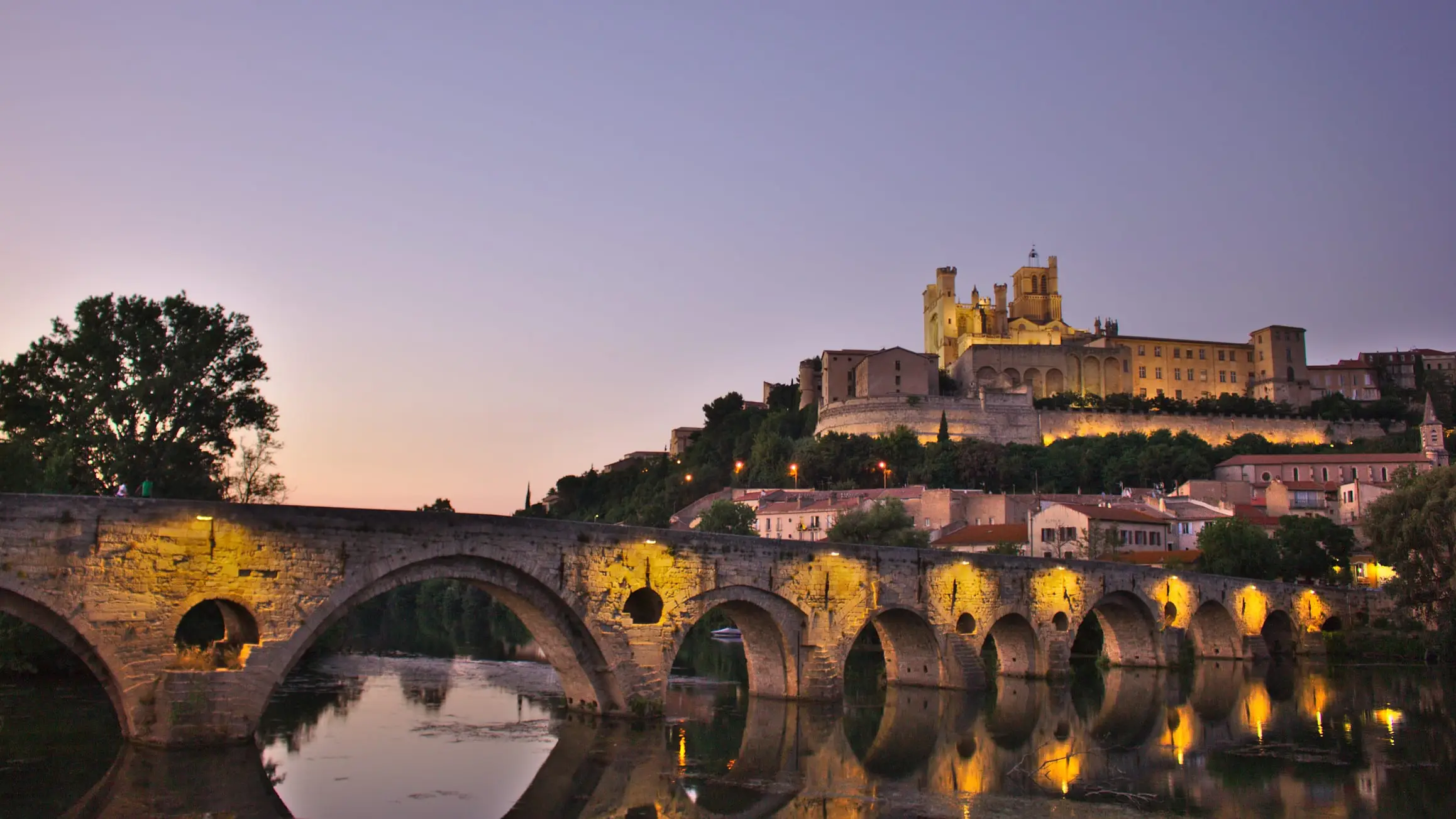
Walk down to the river for the view every local knows. The Pont-Vieux, built around 1134 on Roman foundations, was for centuries the only crossing of the Orb on the main road to Toulouse. Listed as a historic monument in 1963, it now belongs to pedestrians.
At sunset its arches are mirrored in the water beneath the cathedral, as the floodlights come on. Stay until nightfall: this is the image of Béziers you will take home.
Sunday morning: the nine locks of Fonseranes
The next day, head west of the city, where the Canal du Midi descends to the Orb by a staircase of water like no other: eight oval basins and nine gates over 312 metres, for a drop of 21.5 metres. Pierre-Paul Riquet, born in Béziers in 1609, never saw his canal in use: he died in 1680, a few months before it opened in the spring of 1681.
The Canal du Midi has been a UNESCO World Heritage Site since 1996, and Fonseranes is one of its most visited places. In season, wait for a boat to work its way through the locks: a lesson in patience, and in engineering.
Then follow the towpath downstream. The Orb aqueduct, opened in 1858, carries boats 240 metres over the river; before it, they had to cross the river itself. A bridge with a canal on top: worth the walk.
Sunday afternoon: the sea or the vines
Béziers is inland, but it has a rare advantage: the Mediterranean is never far. The nearest beaches are those of Valras and Sérignan, and the beaches of the Agde coast are only a little further; our guide to the beaches between Agde and Sérignan helps you choose. If you prefer the countryside, this is wine country: a tasting at the villa with a wine expert, or a private visit to an estate, rounds off the weekend in a different key.
History lovers will go on westwards, by bike along the towpath, to the Malpas tunnel and the oppidum of Ensérune, a hilltop settlement above the former Montady lagoon and its remarkable star-shaped pattern of fields.
In August: the Feria
Every year around 15 August, the Feria de Béziers takes over the historic centre for five days: bodegas, peñas and brass bands in the streets, bullfighting events at the arena. The street festivities are free to attend. To enjoy them at your own pace, choose a villa a little out of town: you join the excitement in the evening and wake to peace and quiet.
Where to stay near Béziers
For a weekend like this, a villa on the edge of town changes everything: you come back for a quiet lunch, swim between visits and dine outdoors. Villa Andria, in Béziers, is built around its large garden and pool. Villa Joy, near the Orb at Murviel-lès-Béziers, offers space and nature. You will find them all among our villas near Béziers.
Béziers airport has flights from the UK and Ireland in summer, and our concierge service can arrange your transfer, book your tables, have your groceries delivered before you arrive or bring in a chef for Saturday evening.


