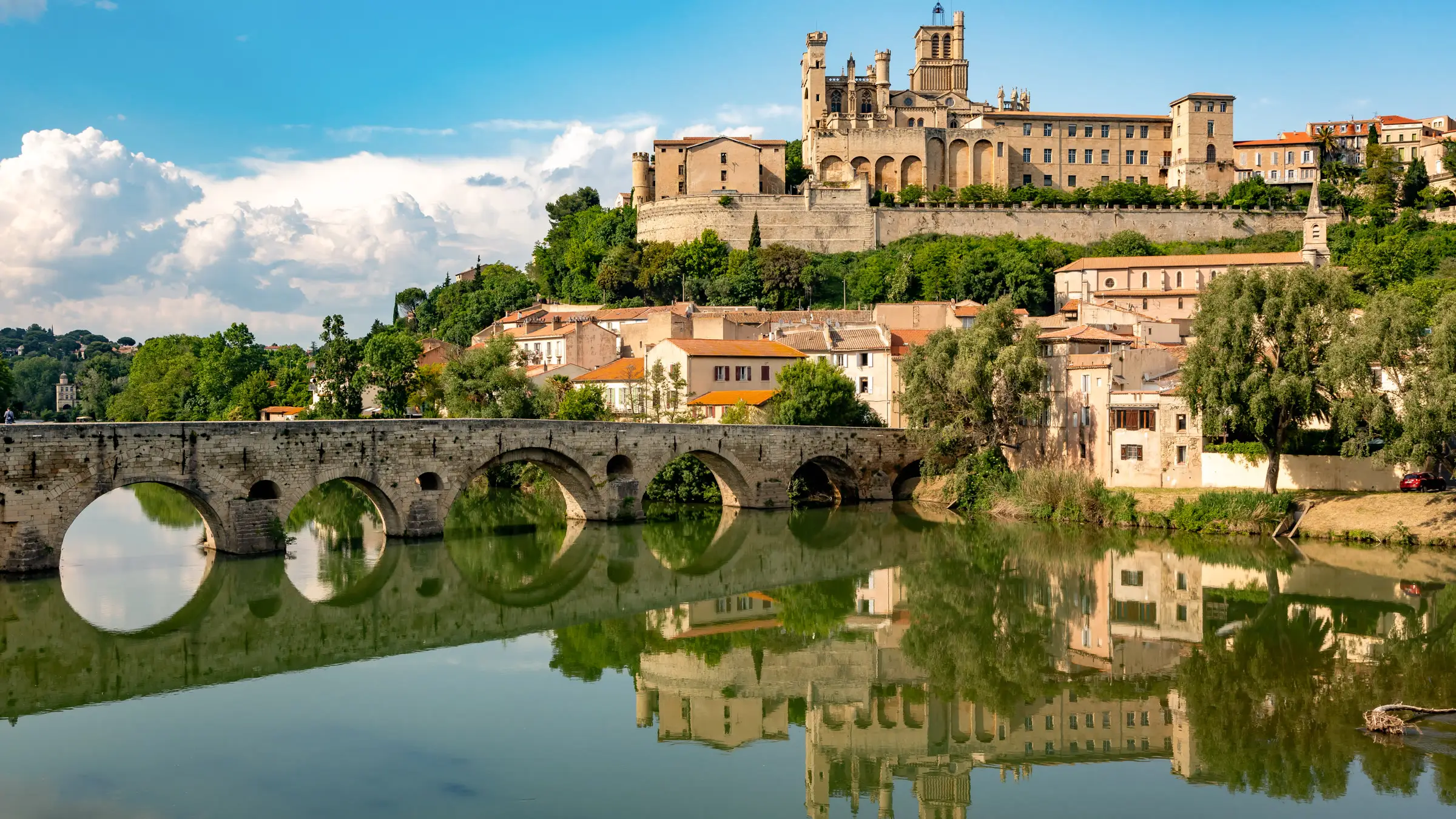
Béziers gave France two of its greatest names: Pierre-Paul Riquet, who linked the Atlantic to the Mediterranean, and Jean Moulin, who united the French Resistance. A great sculptor too, Jean-Antoine Injalbert. Their home town keeps their mark within easy walking distance, and three churches recall what its history cost it.
Pierre-Paul Riquet, the man behind the canal
Pierre-Paul Riquet was born in Béziers in 1609. Nothing destined him for engineering: he made his career in the gabelle, the salt tax administration, rising to become tax farmer for the Languedoc and Roussillon. It was this financier, not a royal engineer, who conceived of carrying water from the Montagne Noire to the Naurouze watershed, and so joining the two seas.
Louis XIV signed the edict in October 1666 and work began in January 1667. Riquet died in Toulouse on 1 October 1680; the canal opened in 1681, completed by his sons. In Béziers, his statue, a work by David d’Angers unveiled in 1838, stands in the middle of the tree-lined avenue that bears his name. The Canal du Midi has been a UNESCO World Heritage Site since 1996.
Fonseranes, his boldest creation
West of the city, the Fonseranes staircase of locks strings together eight oval basins and nine gates: 312 metres long for a drop of 21.5 metres. The whole site has been listed as a historic monument since 1996, like the canal itself. It is easier to appreciate from above, once you know its story; we have written a cycling route along the towpath.
Jean Moulin, the boy from the rue d’Alsace
Jean Moulin is one of the great figures of the French Resistance, the man de Gaulle sent to unite its scattered movements. He was born in Béziers on 20 June 1899, at 6 rue d’Alsace. His father taught history and geography at the Collège Henri-IV, where the son would also study. He drew a great deal, and later signed his drawings “Romanin”. In 1925 he became the youngest sub-prefect in France, then a prefect.
The rest belongs to national history: the unification of the Resistance movements, the first meeting of the National Council of the Resistance on 27 May 1943, his arrest at Caluire on 21 June, his death on 8 July 1943. His ashes were placed in the Panthéon on 19 December 1964.
In Béziers, a plaque on his birthplace was unveiled on 6 October 1946 by Georges Bidault. The monument on the Plateau des Poètes, the work of the sculptor Marcel Courbier, dates from 1951. A walking trail offered by the tourist office links these places and a few others.
Injalbert, the chisel of Béziers
Jean-Antoine Injalbert was born in Béziers in 1845 and died in 1933. A sculptor of renown, he left his home town the Fontaine du Titan, dating from 1893, on the Plateau des Poètes. Much of his work is kept in the Musée des Beaux-Arts, to which his widow donated the contents of his studio in 1934.
Saint-Nazaire, the city raised again
At the top of the hill, Saint-Nazaire cathedral preserves the memory of 22 July 1209: on that day, during the Albigensian Crusade, the city was taken and the Romanesque building burned. Rebuilt in the Gothic style from the middle of the thirteenth century, it was listed as a historic monument as early as 1840. From the Jardin des Évêques, the view takes in the Orb, the Pont-Vieux and the plain.
For the rest of the city, we refer you to our weekend in Béziers.
Saint-Aphrodise, the memory of beginnings
In the old town, tucked in among the houses, the basilica of Saint-Aphrodise bears the name of the first bishop of Béziers and its patron saint. Tradition holds that he was beheaded and then buried himself in a cave: the present crypt evokes it. Built on an early Christian necropolis, the church, remodelled between the twelfth and fourteenth centuries, has been protected as a historic monument since 1983.
In the crypt lies an early Christian sarcophagus decorated with a lion hunt, which specialists date to around 320. Visits are run by volunteers: enquire before you come.
La Madeleine, plain and solemn
The church of La Madeleine, mentioned as early as 1092, is Romanesque in its utter simplicity. It was here, on 22 July 1209, that according to the chroniclers part of the population who had taken refuge inside was massacred: the bloodiest episode in the history of Béziers. A few traces of the fire lit by the crusaders can still be read in the stone. Protected as a historic monument since 1987, it was restored in 1999.
Where to stay around Béziers
To read Béziers without counting your steps, a villa close to the city leaves time for a quiet lunch and a cool return. Villa Andria is in Béziers itself; Villa Joy, at Murviel-lès-Béziers, opens onto the countryside around the city. You will find every villa around the city on our page villa rental in Béziers.
Our concierge service books your visits, arranges your transfers and prepares your arrival.


