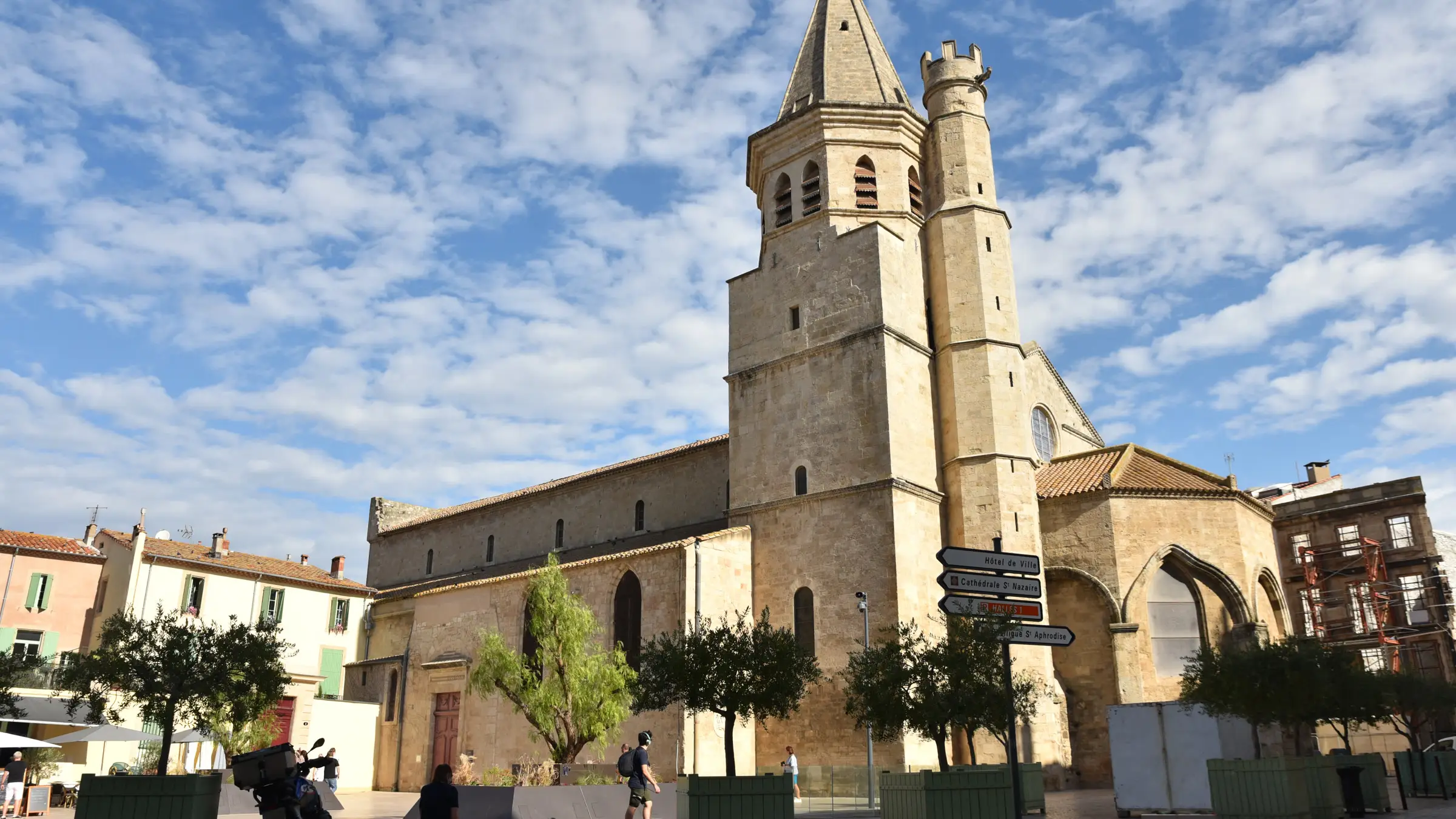
Béziers says so, and the people of Béziers are convinced of it: theirs is the oldest city in France, founded by Greeks who settled on its hills before those of Marseille. The city claims the title with pride, and it has plenty to feed that pride: twenty-six centuries of history, which you can still walk through today.
A conviction the city holds dear
The French state says as much. In January 2020, when it awarded Béziers the label Ville d’art et d’histoire (Town of Art and History), the Ministry of Culture noted that the city took shape as early as 625 BC, with the arrival of the Greeks: some twenty-five years before Marseille, traditionally dated to about 600. The people of Béziers call it Rhodè, in memory of Greeks from Rhodes.
This reading rests on the excavations at the Place de la Madeleine in 1985 and 1986, then on trial trenches and digs carried out since in the old town and on the Saint-Jacques hill. The archaeologists Christian Olive and Daniela Ugolini, a CNRS researcher, have devoted a body of reference work to this first city, which they call Béziers I, from papers in the journal Documents d’archéologie méridionale to Béziers I, 600-300 av. J.-C., la naissance de la ville (2006) and the volume of the Carte archéologique de la Gaule devoted to Béziers (2012). For the people of Béziers, it confirms what they have always known about their city.
What nobody disputes
From the sixth century BC, Béziers was a major fortified settlement on the route linking the Hérault and Aude valleys. Exchanges with the Mediterranean world began early, and Greek influence can be read in the pottery of the fifth and fourth centuries. Here is a city that, very early on, looked to the sea and traded across it.
Some archaeologists remain more cautious about the phrase “Greek foundation”. The debate is less about a date than about a word, and excavation continues: each year, the people of Béziers see in it more reason to hold to their view.
And Agde?
Agde, its neighbour, also traces its history back to the Greeks. Academic work dates it to roughly 550 to 525 BC, founded from Marseille. We tell the story in Agde, city of basalt. Two Greek cities so close together say a great deal about the richness of this coast.
From Baeterrae to today
The Roman city, Baeterrae, is better documented. It was refounded as a colony of veterans of the Seventh Legion, around 36 BC according to the sources, on the Via Domitia, which linked Italy to Spain. Its full name, Colonia Julia Baeterrae Septimanorum, preserves the memory.
Of that city, the amphitheatre is the only monument still partly visible. Its foundations lie beneath the buildings of the Arènes Romaines quarter, whose outline can be read in the pattern of the streets, and it has been listed as a historic monument since 2013. In the Îlot des Chaudronniers, a preventive excavation uncovered massive masonry in 2014, perhaps the remains of a theatre, which was protected the following year.
The market hall itself has had its say. During its major renovation, completed in 2024, works in the basement uncovered a Roman mosaic that once decorated a domus, a wealthy townhouse of the ancient city. Beneath the market you stroll through on a Saturday morning lay a house of Baeterrae.
The Saint-Nazaire and Saint-Jacques hills are where the city places its origins: here you can gauge what has been built over more than twenty-five centuries. The Musée du Biterrois, housed in the Caserne Saint-Jacques and rich in archaeological collections, is currently closed to the public.
For the rest of the city, we refer you to our weekend in Béziers and to Béziers: in the footsteps of Riquet and Jean Moulin.
Ensérune, a Gaulish village within easy reach
At Nissan-lez-Ensérune, a few kilometres away, the oppidum of Ensérune is one of the great Gaulish villages of the Mediterranean South. A national monument run by the Centre des monuments nationaux, it comes with a museum that brings together the objects found on the site, in which Iberian, Celtic, Greek and Italic influences can be read. It makes a good counterpoint to the debate in Béziers: contact with the Mediterranean shows in the objects, at the heart of a Gaulish village.
Where to stay around Béziers
To read the city at your own pace, a villa close by leaves time for a visit in the morning and a return to calm in the afternoon. Villa Andria is in Béziers itself; Villa Joy, at Murviel-lès-Béziers, opens onto the countryside around the city. You will find every villa around the city on our page villa rental in Béziers.
Our concierge service books your visits, arranges your transfers and prepares your arrival.


